“We’re here to keep stories.” – Joy Harjo, on the purpose of our lives
Maria Girouard (Penobscot, former Wabanaki REACH director) understands the power of story.
While organizing for the Maine-Wabanki Child Welfare Truth and Reconciliation Commission (TRC), she witnessed how systems—like child welfare—require the stories of those most affected to move a conversation “from the head to the heart.” When community members were assured that their stories would be heard and valued, something shifted. People gathered to share deeply personal truths about their lived experiences, and in that sharing, the possibility of healing emerged.
During these TRC gatherings, Maria began to notice a recurring desire within Wabanaki communities: the need for a similar truth-telling space focused on a different system, this time the land. Again and again, she heard the refrain—we could really use a truth-telling around the Maine Indian Land Claims.
(For more information on the Maine Indian Land Claims and the Maine Indian Claims Settlement Act, see endnote. )
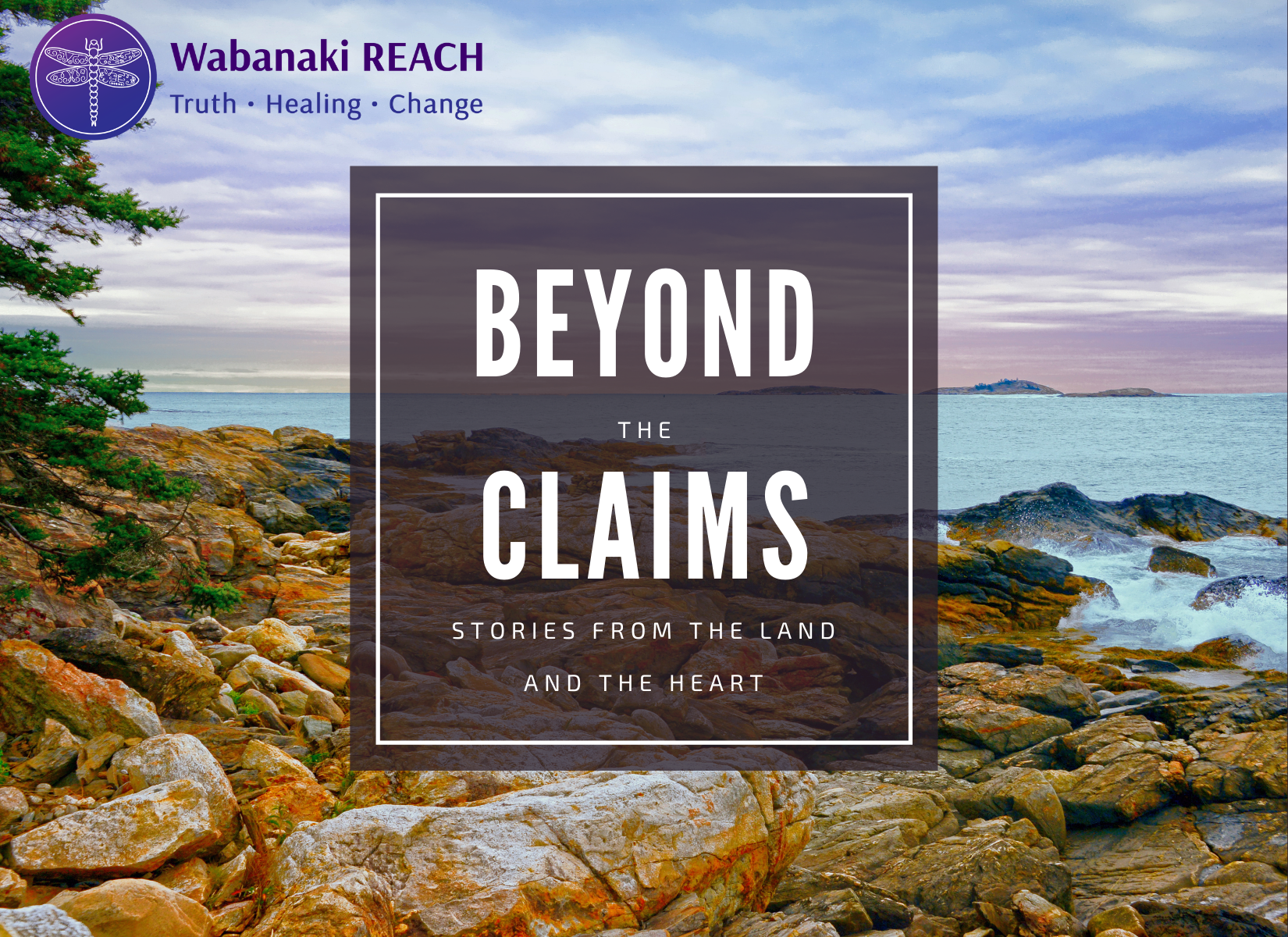 Maria planted the seeds of an idea. Over time, it blossomed into Beyond the Claims: Stories from the Land and the Heart, a project that would extend the TRC’s core principle—centering the stories of those most affected—into a complex and often abstract historical issue.
The Maine Indian Claims Settlement Act of 1980 is frequently treated as a legal or political matter, the domain of scholars and policymakers. Beyond the Claims reframed it as something lived and felt. Beginning with oral histories from those who experienced the decade leading up to the settlement, the project became what Maria describes as a “vessel of stories,” expressed through audio recordings, photographs, and even a devised theater piece.
Recently, the project reached a new milestone: the opening of its archived oral history collection at the Bowdoin College Library. On April 22, 2026, members of the Wabanaki REACH community and the broader public gathered to mark the occasion.
The celebration opened with Wikhikonol, a photographic installation by Maya Attean (Penobscot/Passamaquoddy) and Nolan Altavater (Passamaquoddy). The images—depicting places deeply familiar within Wabanaki homelands—played a vital role in telling the story of Beyond the Claims. As Maria explained, the installation “returns the land to the conversation,” reminding viewers that the original claims were, at their core, about land—land that was taken, remembered, and remains central to Wabanaki identity. She noted that even the 1980 Act itself omits the word “land,” a telling absence. In contrast, the photographs ground the narrative in place: landscapes that comfort, sustain, and endure in memory.
The evening continued with a panel featuring project coordinator Kate Russell, story-gatherer Juanita Grant, and story-giver Darrell Newell. Together, they reflected on the process of collecting and sharing these histories.
Kate Russell noted how grateful she was to have learned so much in the process of coordinating Beyond the Claims. Part of that learning was “unlearning” as a non-Native person working under the direction of Wabanaki leaders. She said the undertaking was ultimately a “gift,” as her world view and understanding of history and people was expanded.
Darrell Newell, the former vice-chief of the Passamaquoddy Tribe at Motahkomikuk, described how it felt important to him that he be able to share his perspective, an opportunity he sees as “important for all Tribal people.” He noted as someone who was born decades before federal recognition, his story spans the time when the Wabanaki were wards of the state of Maine, to federal recognition in the mid ‘70s, to the erosion of tribal-state relations as Maine further encroached on Tribal sovereignty.
Prior to the Land Claims, he recalled that although his community lived in poverty, they were “rich in culture, language, and identity.” After the Land Claims led to federal recognition, he explained that the Tribes “were better able to care for our own people.” Through his story, one can trace both the initial joy surrounding the Land Claims and the later dissatisfaction with how the state has interpreted the settlement. His story in the archive can be found at this link.
For Juanita, the act of listening was transformative. “Interviewing for Beyond the Claims was one of the most sacred experiences I have ever had,” she said. “By holding space for people’s stories, I came to better understand my own history.”
That sense of reciprocal exchange—of giving and receiving—echoed throughout the event. In her remarks,Maria recalled a moment from the TRC: after the final report was presented, silence filled the room until an elder spoke. “Thank you,” they said. “I feel heard.”
That simple acknowledgment captures the essence of both of REACH’s truth-telling projects. To tell a story is to offer a gift; to listen is to affirm its value.
Now housed within Bowdoin’s digital library, the Beyond the Claims archive invites that exchange to continue. As Bowdoin archivist Kat Stefko noted, “The collection has much to teach those who wish to learn.” These stories are not meant to sit in isolation. They ask for listeners—for attention, reflection, and relationship.
Beyond the Claims ultimately gestures toward something larger than historical documentation. It offers a model for how we might approach difficult histories—not as distant facts to analyze, but as stories to encounter, carry, and cherish.
Endnotes:
As a quick (and very simplified) refresher, the Maine Indian Land Claims refers to a pivotal time in Wabanaki-Maine history. Over the course of the 1970s, the Wabanaki Nations asserted that Massachusetts and Maine had illegally acquired a huge swath of their aboriginal territory, amounting to two-thirds of the current area of Maine. To legitimize their claim, the Tribes sought to affirm their inherent status as sovereign nations, and in 1975, the government extended overdue federal-recognition of the Passamaquoddy Tribe and the Penobscot Nation. The federal government would now be required to fulfill its trust obligations.
Despite this victory, the land claims remained tumultuous. Due to reasons too complicated for this endnote, the land claims resulted in a settlement in which the Tribes received limited monetary funds to acquire lands. Several ambiguous provisions led to the state of Maine extending its power over the Tribes. While the Tribes retained federal-recognition, they took on the status of municipalities within Maine, a status that limits their exercise of sovereignty.
References: